






Smart thermostats and manual heating controls do the same basic job, keeping your home at the temperature you want, when you want it, but they get there differently. Manual heating controls (a programmer, a room thermostat, and thermostatic radiator valves, or TRVs) are set by hand and stay wherever you leave them. Smart heating controls do everything manual controls do, plus app access, remote adjustment, and scheduling you can change from your phone. Which suits your home usually comes down to how much control you actually want day to day, not which is “better” in the abstract.
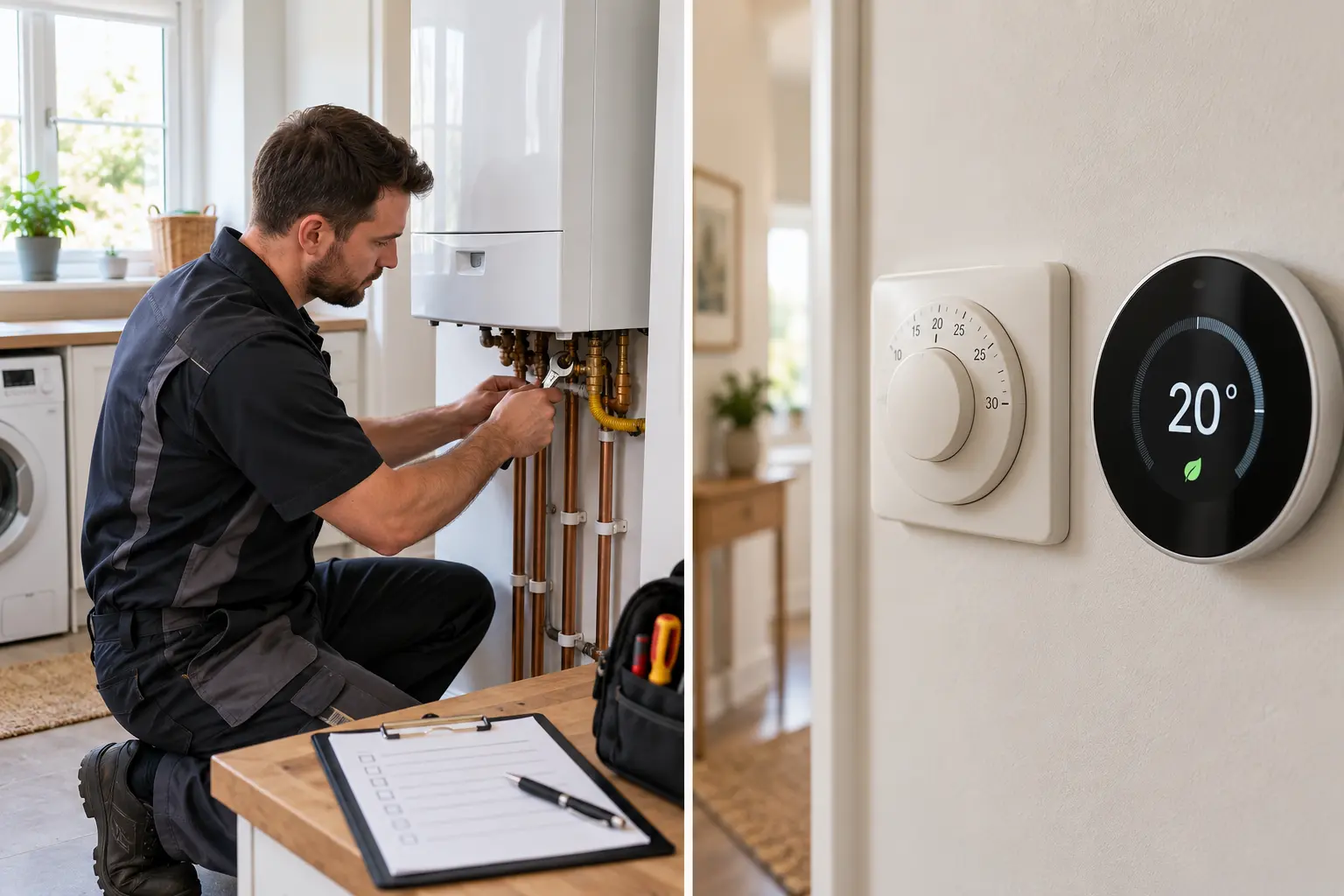
What’s the difference between a smart thermostat and manual heating controls?
A manual system is adjusted at the wall, on the dial or panel itself. You set a schedule on the programmer, set a target temperature on the room thermostat, and turn TRVs up or down room by room. Once it’s set, it stays that way until someone changes it by hand.
A smart thermostat connects to your home Wi-Fi and adds an app, so you can change the temperature or schedule from your phone, whether you’re upstairs or away from the house entirely. Many models also learn your routine over time and can use your phone’s location to adjust the heating as you leave or approach home.
What do manual heating controls include?
A properly controlled heating system, smart or manual, should have all of the following in place:
- A programmer, to set when the heating comes on and off
- A room thermostat, to set an overall target temperature for the home
- Thermostatic radiator valves (TRVs), to control the temperature room by room
- A hot water cylinder thermostat, if your system has a hot water cylinder
These four are the foundation of any well-controlled system. A smart thermostat generally replaces the programmer and room thermostat, while TRVs and a cylinder thermostat carry on working alongside it either way.
What extra do smart heating controls add?
On top of the basics above, smart heating controls typically add:
- Remote control from a phone app, wherever you are
- Flexible scheduling you can change on the fly, rather than only at the wall
- Geofencing, so the heating can respond automatically as you leave or come home
- Learning features, where the thermostat adjusts its own schedule based on your habits
- Room-by-room or zone control, on systems with smart TRVs fitted to individual radiators
None of this is essential to a working heating system. It’s added convenience and flexibility on top of controls every home needs anyway.
Do smart thermostats actually save money?
It depends on how you’re controlling your heating already. Energy Saving Trust estimates that installing proper heating controls in general could save a typical UK household in the region of £100 a year, and separately, that turning your room thermostat down by just 1°C could save a similar amount again. Their own guidance is clear that a smart thermostat “can do everything that conventional controls do,” and whether it saves you anything extra depends on your current setup, not a guarantee that comes with the device itself.
In practice, a smart thermostat tends to help most if you currently leave the heating running on a fairly loose schedule, or often forget to turn it down when you’re out. If you’re already disciplined about programming and adjusting manual controls, the savings gap narrows considerably.
Will a smart thermostat work with your boiler and heating system?
Most smart thermostats are designed to work with combi, system and regular boilers, but compatibility depends on your existing wiring and boiler make. Some installations are straightforward; others need a compatible receiver or an engineer to check the wiring before fitting one. If you want multiple rooms controlled independently, that generally means adding smart TRVs to individual radiators as well as the main thermostat, not just swapping the thermostat alone.
It’s worth having this checked by an engineer rather than guessing from the boiler model, since older systems and unusual wiring setups are the most common reason a DIY smart thermostat install doesn’t go to plan.
Which suits your home?
Manual heating controls are the simpler choice if:
- You want the lowest upfront cost
- Your household keeps a fairly consistent daily routine
- You’re happy to adjust the thermostat or TRVs by hand
- You’d rather not rely on an app or Wi-Fi to control your heating
A smart thermostat is worth considering if:
- Your schedule varies week to week and a fixed programme doesn’t fit
- You want to turn the heating on remotely before you get home
- You often forget to turn the heating down when you go out
- You want room-by-room control without walking round adjusting each TRV
Common questions about heating controls
Can I add TRVs without replacing my boiler?
Yes. TRVs fit onto individual radiators and work alongside your existing boiler and thermostat, so they can usually be added on their own.
Do I need Wi-Fi for a smart thermostat to work?
For the app, remote scheduling and geofencing, yes. Most models will still run their basic schedule if your internet drops, but the smart features need a connection.
Can a smart thermostat be fitted alongside my existing manual controls?
It typically replaces the room thermostat and programmer, while TRVs and a cylinder thermostat, where fitted, stay in place and keep working alongside it.
Not sure which is right for your system?
Whether it’s fitting smart TRVs room by room or getting your existing manual controls working properly, our heating controls service covers both, with straightforward advice on what your system can actually support. Get in touch and we’ll take a look at your setup before you decide.